Case study · Mobile App / Inventory & Accounts · 2026
Stokit
Take control of your stock. Speed up your business.
A mobile inventory app that lets small businesses manage products, variants, barcodes, stock movements, customer accounts and financial reports from their phone. Built end to end by Loria Digital.
stores from one codebase: App Store and Google Play
Offline
stock movements that work without internet
Barcode
scanning, generation and PDF labels
RLS
each business's data isolated at row level
Results in numbers
We measured the live site with Google's Lighthouse and took page counts from the site's own sitemap.
How it performs today
www.stoktakip.app
96
Performance
96
Accessibility
79
Best practices
100
SEO
Largest content (LCP)
2.5 s
Layout shift (CLS)
0
Page weight
733 KB
Requests
26
Lighthouse 12.3 · mobile · simulated slow 4G · 13 November 2026. 90+ is green, 50–89 amber.
The project at a glance
2
Platforms (iOS and Android)
33
Pages
The story
Stokit is a mobile-first inventory app we built for small businesses that sell variant-heavy products — boutiques, textile and footwear shops, jewellers and cosmetics retailers. Businesses moving off spreadsheets and paper ledgers can manage every product with its colour, size or karat variants from a phone, scan barcodes, track customer balances and see profitability on a single screen. The app is live on the App Store and Google Play.
01
The problem we solved
Most small retailers track inventory in a spreadsheet, a paper ledger or a WhatsApp thread. Because every colour and size of the same product is squeezed into one row, nobody can see which variant has actually run out; stock counts take days, and customer balances live in a separate book entirely. Stokit merges those three scattered records — inventory, accounts and cash — into one mobile app.
02
Our product approach
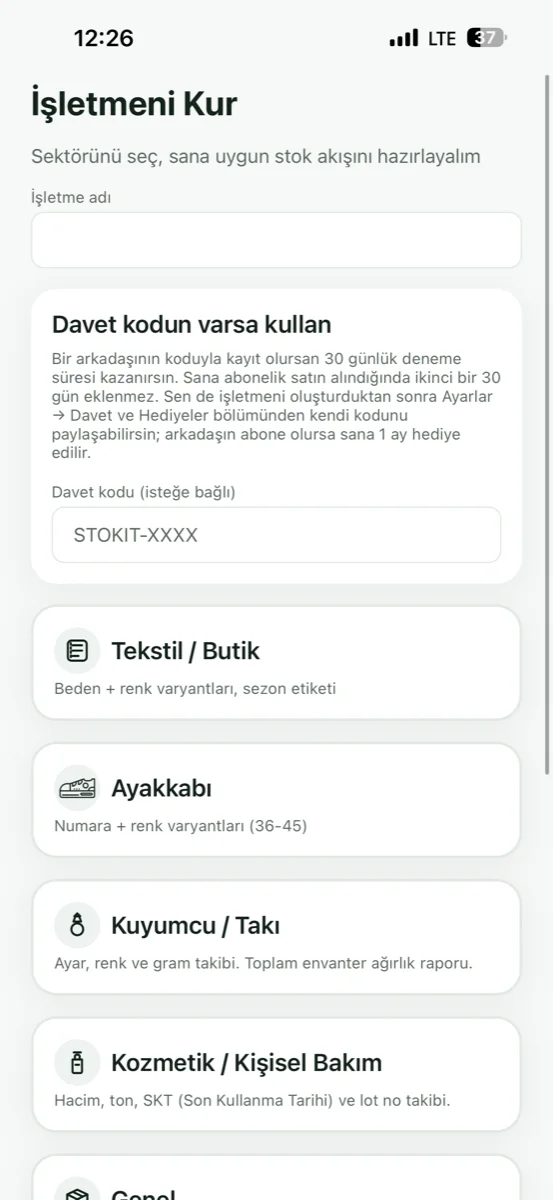
The very first setup step asks what industry the business is in. A textile shop starts with colour and size variants, a jeweller with karat and gram, a cosmetics store with volume and expiry dates. Instead of an empty screen, the owner meets a layout already shaped around their trade — and every variant template stays editable from settings.
03
The migration engine
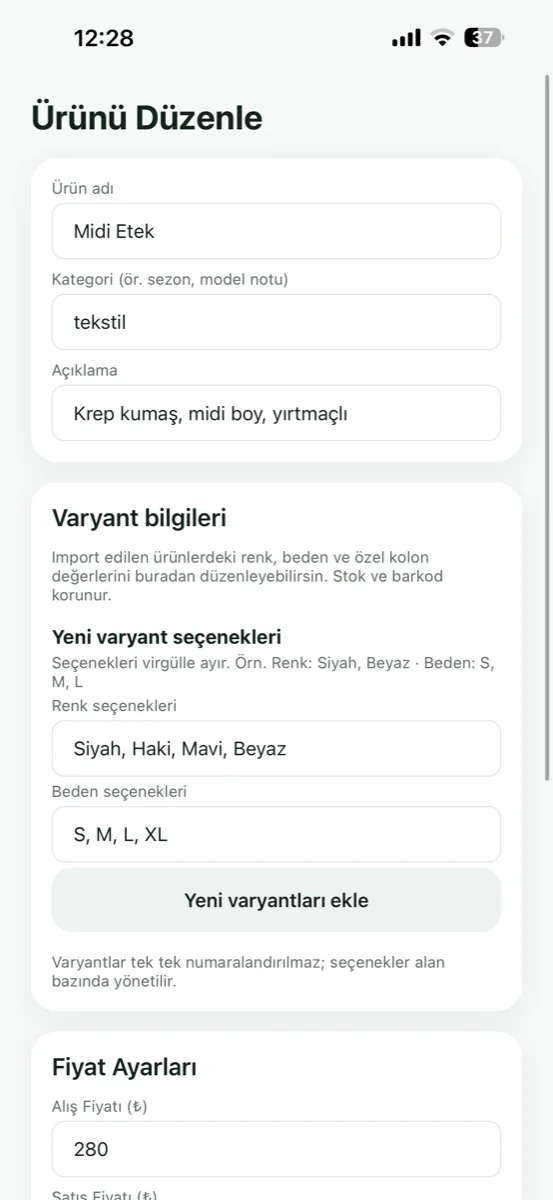
For businesses that don't want to lose their existing setup, we built .xlsx and .csv import. The system finds the header row on its own, maps Turkish and English column names, and turns columns that vary within a product (size, colour, karat) into variants while fixed columns become product data. Unrecognised columns aren't discarded — they're kept as custom variant fields. Every import shows a preview beforehand and can be rolled back afterwards without touching earlier records.
04
Stock, barcodes and alerts
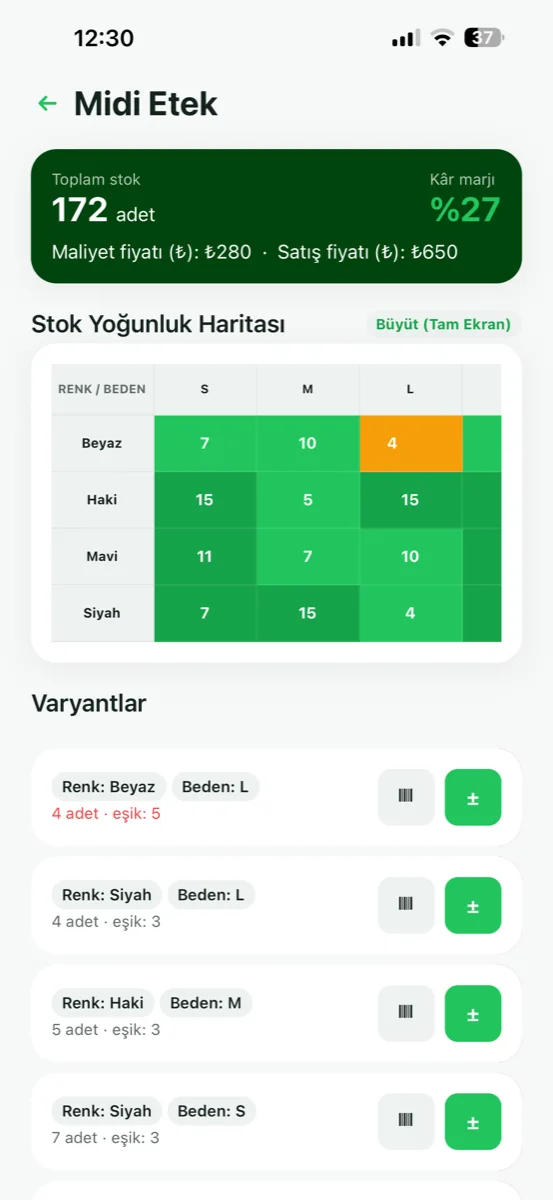
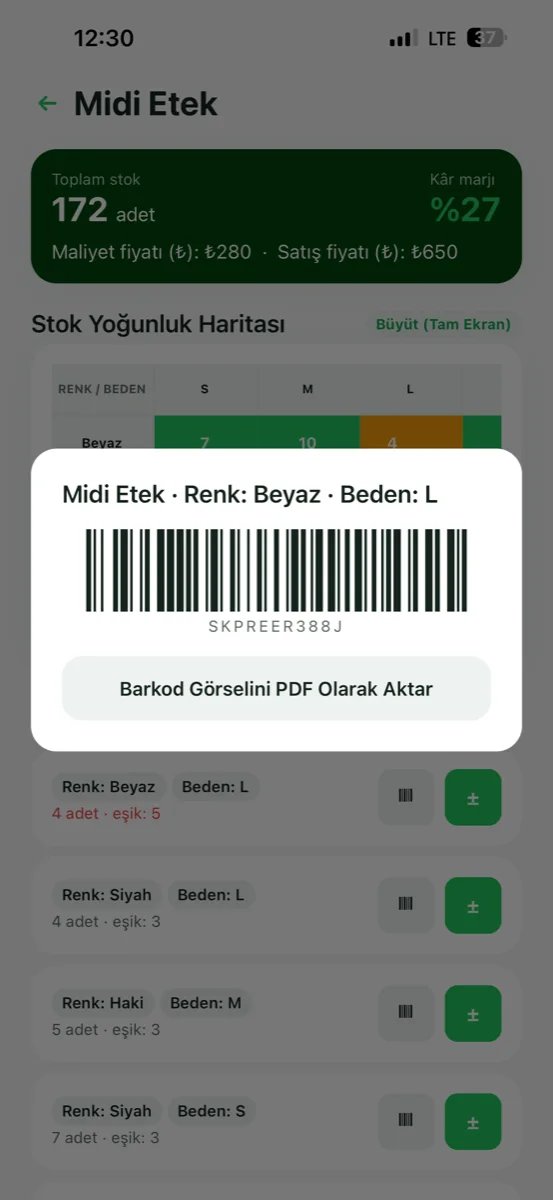
A stock density map on the product detail screen shows at a glance which colour-and-size combination has run dry. Variants without a barcode get a generated Code128 barcode that can be exported as a print-ready PDF label sheet. When a variant drops below its threshold, a server-side trigger sends a push notification straight to the owner.
05
Accounts and finance
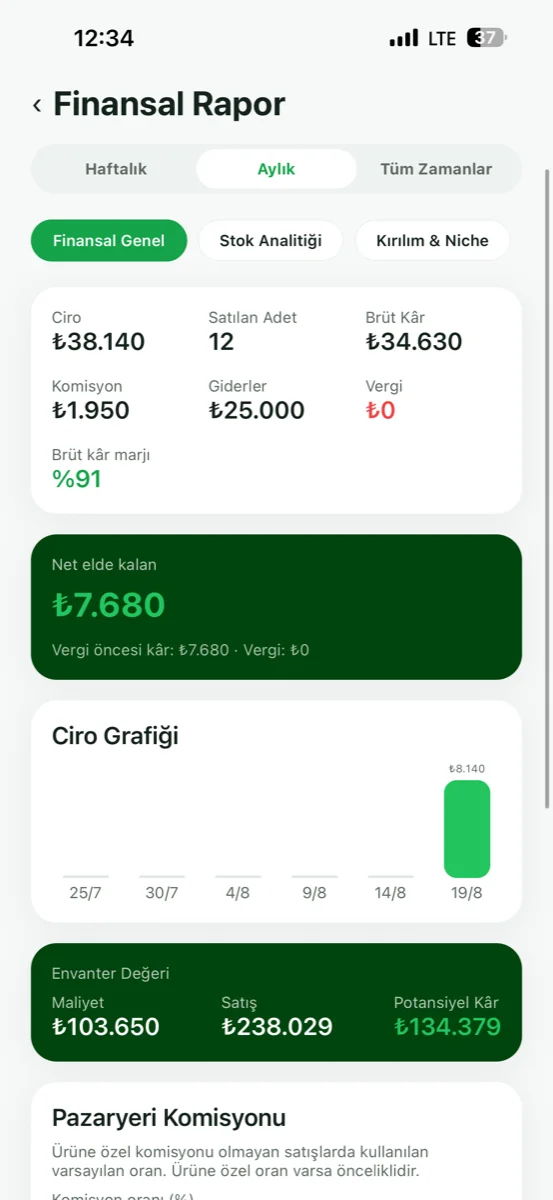
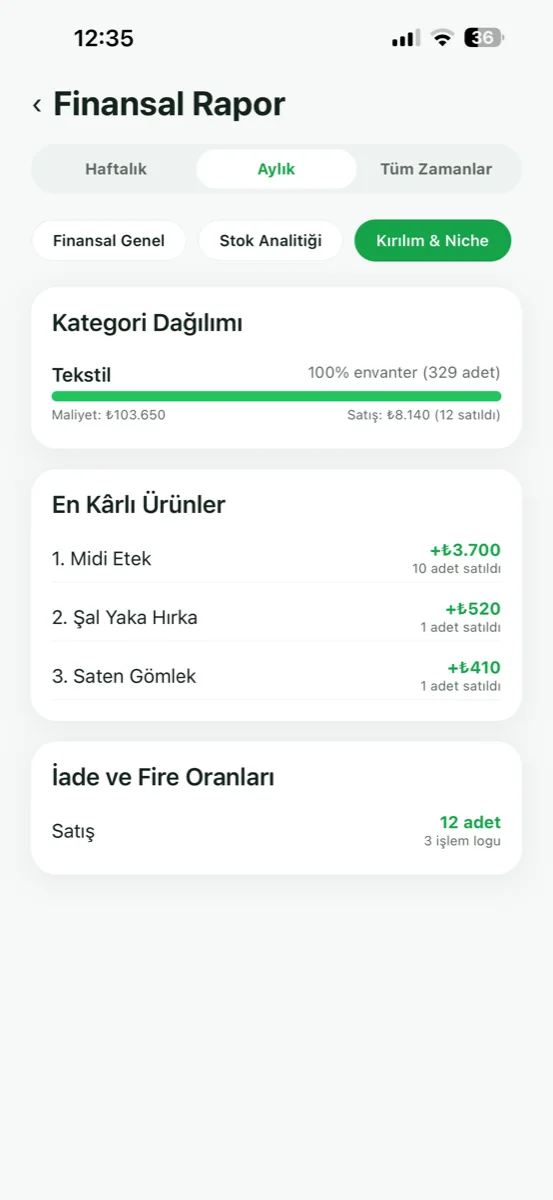
Customer and supplier accounts, sales and purchase documents, instalment plans, VAT and payment records all live inside the app. The financial report screen breaks down revenue, inventory value, expense lines, category-level profitability and return/waste rates across weekly, monthly and all-time views.
06
Technical architecture
The mobile app is written in React Native with Expo SDK 54 and strict TypeScript. Supabase Realtime acts as the source of truth while Zustand and MMKV serve as the UI cache. Authorisation runs through Supabase Auth and RLS policies, low-stock notifications through Edge Function triggers, and subscriptions through RevenueCat on top of App Store and Google Play billing. The marketing site (stoktakip.app) is a Next.js build shipped with a full technical SEO and GEO setup.
Highlights
01
One codebase, two stores
React Native and Expo let us ship iOS and Android from a single source, so every feature lands on both platforms at the same time.
02
Offline-first sync
Stock movements made without a connection are held in a secure on-device queue and synced automatically once the network returns — no interruption in the stockroom, on the shop floor or on the road.
03
Variant-based inventory model
Colour, size, karat, gram and volume are tracked as separate stock units. Every variant carries its own barcode, low-stock threshold, expiry date and lot number.
04
Multi-tenant with isolated data
All businesses run on a single Postgres instance, with Row Level Security policies isolating each tenant's data at the database layer.
Screens from the app
The screenshots below are taken from the app's actual interface.
Industry-based setup — textile, footwear, jewellery and cosmetics templates
Product and variant definition — colour, size, karat, volume
Stock density map — see which variant ran out at a glance
Per-variant barcode generation and print-ready PDF labels
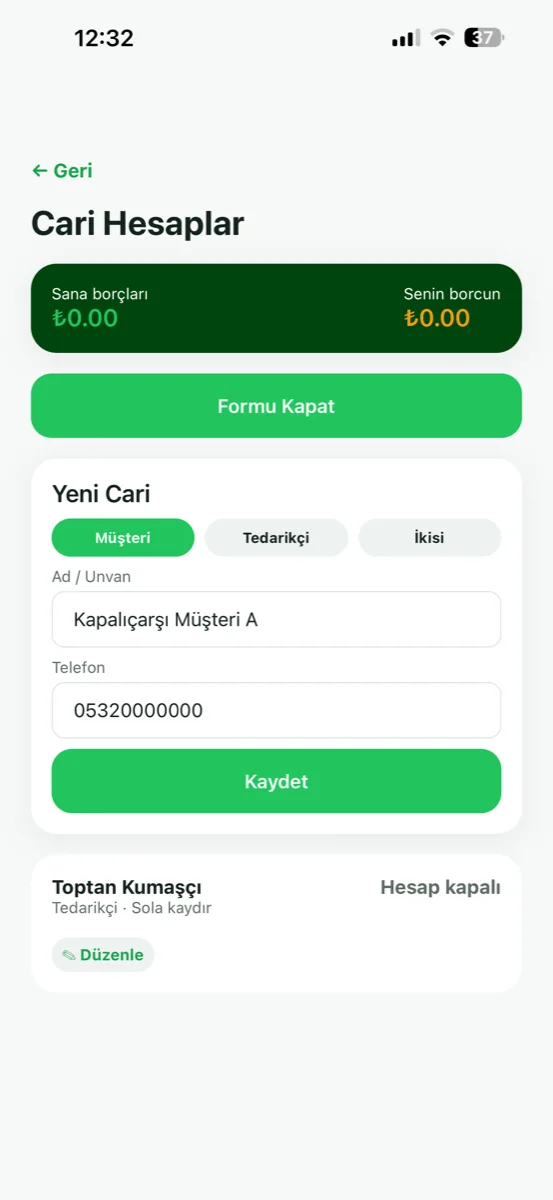
Customer accounts — clients, suppliers and balances
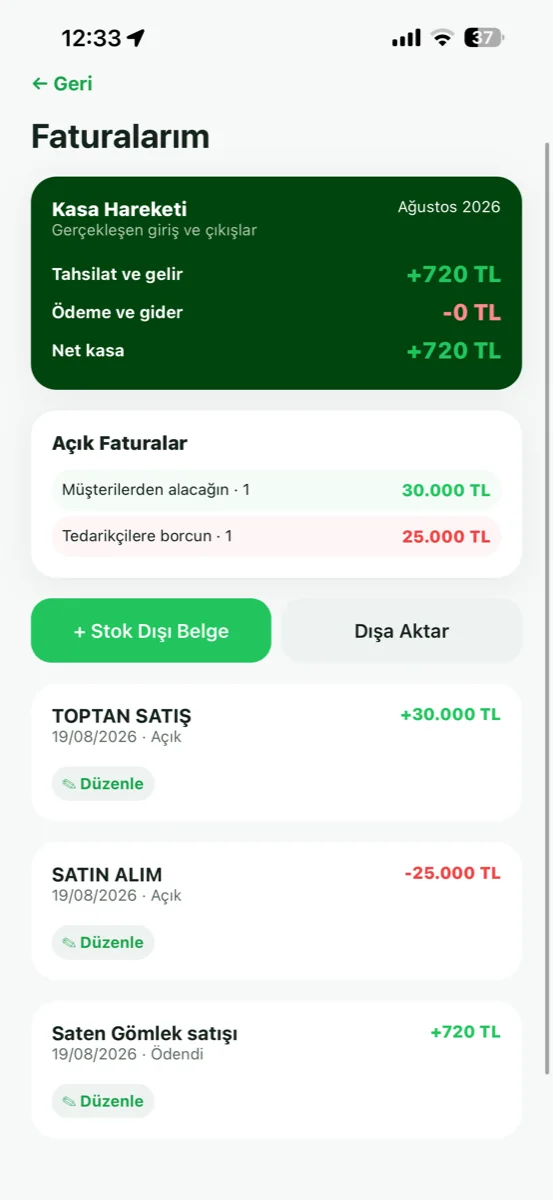
Documents and cash movements — sales, purchases, payments, instalments
Financial report — revenue chart, inventory value and net profit
Profitability analysis — category split, top products, waste rate
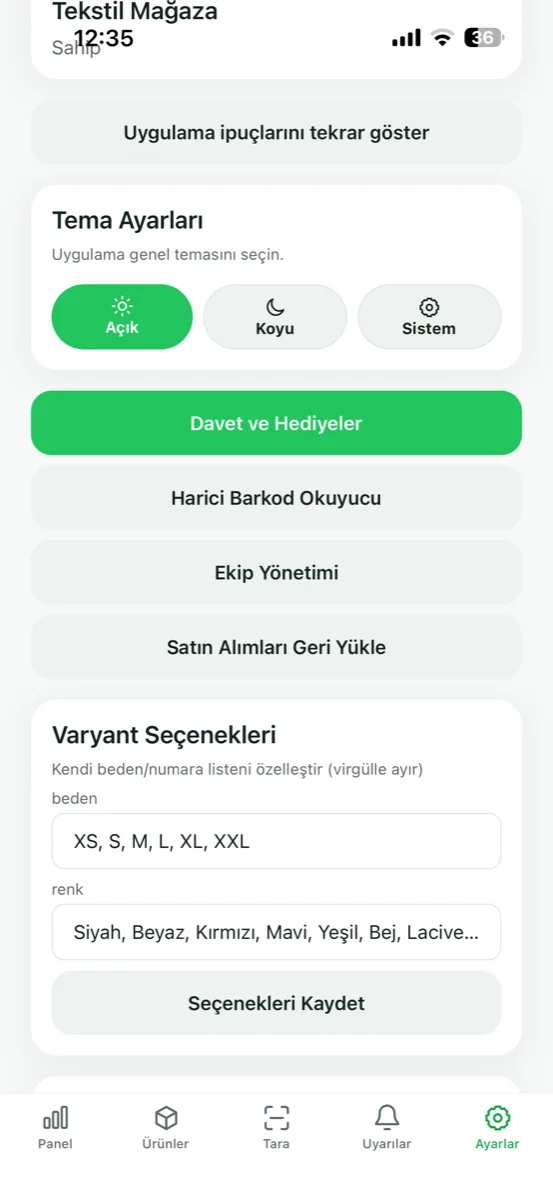
Industry-specific variant templates and theme settings
What we did
Product strategy, information architecture and UI/UX design
React Native (iOS + Android) app development
Supabase data model, Row Level Security and Edge Functions
Excel / CSV import and variant parsing engine
Barcode generation, scanning and PDF label output
Push notification infrastructure and low-stock alerts
Subscription infrastructure (RevenueCat + Play Billing + StoreKit)
Next.js marketing site with technical SEO and GEO content
App Store and Google Play releases, ASO and store creatives
Technologies used
This project was built with the following technologies and techniques.